Home › Circle of fifths
The circle of fifths: hear it before you recite it.
The circle of fifths is a map: it shows which chords go well together and where the music can go next. It is often taught as a chart to memorize. Here you tap it, you listen, and you see why it works.
Try it right here
Turn the sound onTap a chord on the circle to hear it and see where it can go.
Your chord progression
How to read the circle
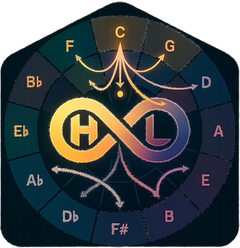
The circle lines up the twelve keys with one simple rule: each step is a fifth. From C you go up to G, then D, A, E, B… and after twelve steps you are back on C.
Two landmarks are enough to find your way:
- The key signature. Moving to the right (C, G, D…), each key gains one sharp. Moving to the left (C, F, B♭…), each key gains one flat. So the circle tells you how many accidentals a key has, with nothing to recite.
- Two rings. Major chords sit on the outside. On the inside, each minor chord sits under its “relative”: A minor under C major, E minor under G major. They use exactly the same notes as their relative major, but the centre changes: A minor comes to rest on A, just as C major rests on C. Hence the darker colour.
The neighbouring slots: your chord family
Pick C on the circle above: the slots around it light up. They are not random neighbours: they are the chords of the key of C major, each with its own function, and you find them in a great many songs. They don't all share notes with C (D minor shares none): what brings them close is the role they play around C.
- G, the dominant (V). It builds tension and pulls towards C.
- F, the subdominant (IV). It generally moves away from C, often more gently than G does.
- A minor, the relative (vi). Same notes as C, but with A as the point of rest: a darker colour.
- D minor (ii). It sets up the dominant: the start of the famous ii, V, I.
- E minor (iii). A soft colour between C and G.
With C, F and G you can already accompany a great many songs. Add A minor and you have the backbone of a lot of pop.
What the circle doesn't tell you
The circle shows what is close. It does not say in which order to play the chords, nor what it feels like to chain them. That is your ear's job.
Take G then C. G is the dominant: it contains the B, which wants to rise to C. When the C chord arrives, you hear an arrival, a rest. Going from C to G does the opposite and leaves the phrase open, like a question. Musicians call this tension and resolution, and it drives most chord progressions. The circle shows you where the tension is; playing is how you learn to recognize it.
Four short piano exercises
You don't need to understand everything first. Play first, then ask yourself what you heard.
- C, G, C. Hold each chord for four beats. Feel the return to C: it is a small sigh of relief. Then try C, F, C and compare: the feeling of arrival is weaker.
- Going round the circle. Play C, F, B♭, E♭… moving down by fifths. Each chord is the dominant of the next. Listen to how the sequence pulls forward.
- The family of C. Play C, A minor, F, G. Four neighbouring chords on the circle, and yet a real song. Say out loud why each one belongs.
- The intruder. Repeat exercise 3 and replace F with D♭, which sits on the far side of the circle. What changes? You have just felt what “far from the circle” means.
Going further in HarmoLink
The circle on this page is a short version. In the app it goes much further:
- the full circle of fifths, with an explanation for each chord (free);
- chord recognition from what you play on a MIDI keyboard (free);
- a chord grid to keep your progression, choose arpeggios and rhythms, and write a melody (free);
- the dictionary, scales and modes (free);
- Learn mode, to play your progression step by step on piano or guitar (Pro, with a 7-day trial, no card).
Your next song starts with one chord.
Open HarmoLink, tap the circle, listen, and let your ear lead the way.